Standard Library
AWK ships with about 20 builtin functions. zawk adds a standard library of ~190 functions, inspired by the standard libraries of DuckDB, ClickHouse, Go, Rust, Deno, PHP and Java's commons-lang, so that the common work of data processing does not need a pipeline of other tools.
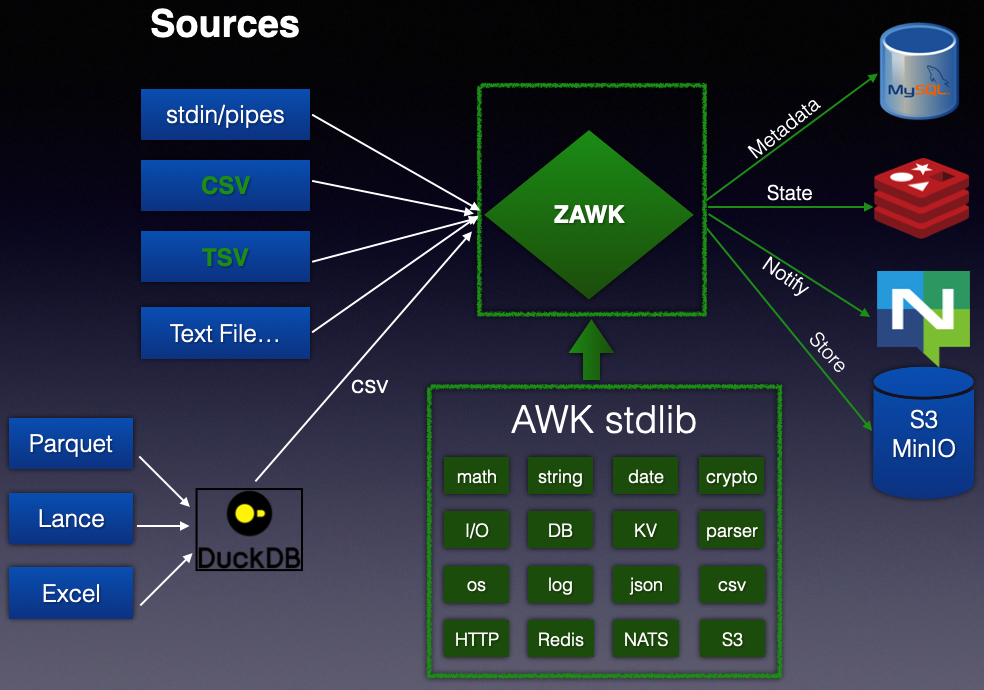
Categories
| Category | Functions |
|---|---|
| Text | trim, truncate, pad, mask, starts_with, contains, camel_case, snake_case, title_case, similar, wrap, words, parse, rparse, format_bytes, figlet, ... |
| Parsers | url, data_url, shlex, path, semver, pairs, record, message, func, tuple, variant, parse_array, flags |
| JSON / XML / HTML / CSV | from_json, to_json, json_flatten, json_value, json_query, json_set, xml_value, html_query, from_csv, to_csv |
| Array & Math | seq, uniq, asort, asorti, _sum, _mean, _median, _quantile, _stddev, _top, bloom filter, abs, round, eval, fend, min, max |
| Date/Time | systime, strftime, mktime, datetime, duration |
| Crypto & Encoding | digest, hmac, encrypt, decrypt, jwt, dejwt, encode, decode, uuid, ulid, tsid, snowflake |
| Network | http_get, http_post, send_mail, s3_get, s3_put, publish, local_ip, jev* |
| Database & KV | sqlite_*, mysql_*, pg_*, kv_get, kv_put, kv_delete, kv_clear |
| OS, I/O & Misc | getenv, system2, read_all, write_all, read_config, var_dump, log_info, typeof, version, fake, hex2rgb |
Discover functions from the command line
Don't guess function names or argument orders: ask zawk. It is never out of date.
zawk functions                 # all functions, grouped by category: signature, summary, example
zawk functions json            # functions whose name contains "json"
zawk functions Crypto          # one category
zawk functions --json trim     # machine readable, one function per line
{"name":"trim","category":"Text","signature":"trim(s: str[, chars: str]) -> str",
 "params":[{"name":"s","type":"str","optional":false},{"name":"chars","type":"str","optional":true}],
 "returns":"str","summary":"Remove whitespace, or any of chars, from both ends of s.","example":"trim(\"[hello]\", \"[]\")"}
There is also a printable cheat sheet.
Conventions
Arrays as results. Functions documented as returning map[...] return an AWK array. Index the call directly
(url($1)["host"]) or assign it (u = url($1)). Use var_dump(x) to see the structure on stderr.
Failures are warnings, not crashes. Functions working with external services or user-supplied input
(network, KV, databases, crypto, parsers) print a warning to stderr and return an empty value ("", an empty
array, or 0 for an HTTP status). Each distinct warning is printed once. The failure also sets ERRNO:
ERRNO = ""
rows = sqlite_query("app.db", "select name from users")
if (ERRNO != "") { print "query failed: " ERRNO > "/dev/stderr"; exit 1 }

# or, in one expression and without the warning:
rows = try sqlite_query("app.db", "select name from users") else fail("query failed: " ERRNO)
Your functions win. A user-defined function with the same name as a stdlib function (such as trim, max
or abs) takes precedence over it in the whole program, so existing AWK programs that define these helpers keep
working. The POSIX/gawk builtins (length, substr, split, gsub, sprintf...) cannot be redefined.
Parentheses are required. Builtin functions must be followed directly by (: length($1), not length ($1).
gawk functions. gensub, patsplit, strtonum, asort, asorti, systime, strftime, mktime,
typeof, isarray and the bitwise functions behave as in gawk.